Planning your child's education fund without derailing your retirement
Put a date and a rupee figure on the course, start early, keep the money separate from retirement, and shift to safer options as the date nears. Education can be borrowed for; retirement cannot.

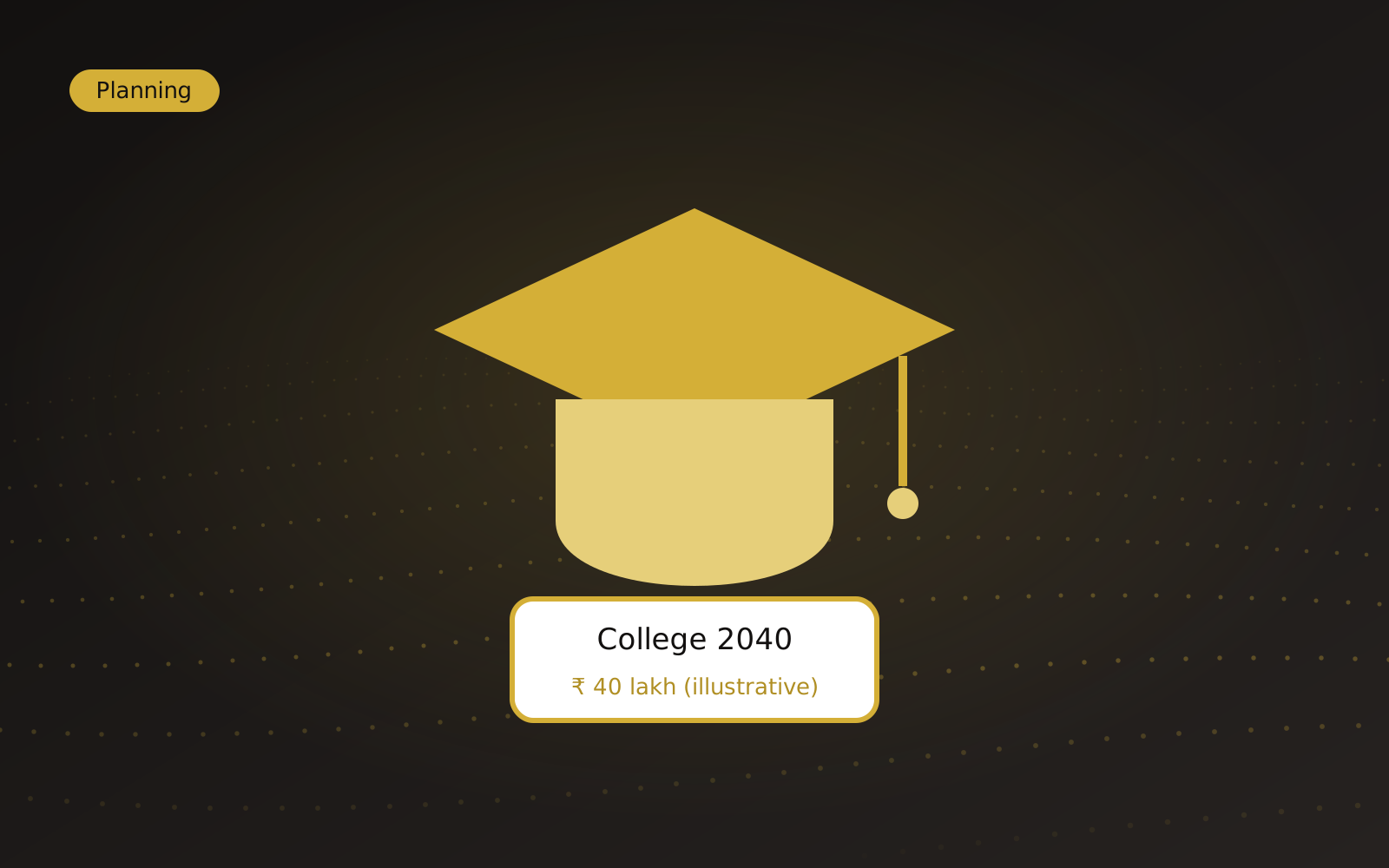
Plan a child's education fund by naming the course, the year, and today's cost, then building towards that figure in a separate pot that never mixes with retirement money. Start early, move towards safer options as the date nears, and remember that a child can borrow for college but you cannot borrow for your retirement. This guide walks through the figure, the schedule, the separation, and the two conversations, one with your child and one with grandparents, that make the plan hold.
Put a date and a rupee figure on it
Vague goals do not get funded. "Something for the kids" becomes a number only when you answer three questions: which course, in which year, and what it costs today.
Say your daughter is eight and you expect her to start an engineering degree at eighteen. Today a four-year programme at a good private college might cost ₹12 lakh including hostel. Assume education costs rise at 8 per cent a year, which is higher than general inflation and has been for a long time. In ten years that ₹12 lakh becomes roughly ₹26 lakh. That is the goal, with a date: ten years from now.
If a postgraduate degree abroad is on the table, the figure is larger and the currency risk is real. Plan for the course you can see today, and revisit the figure every year. You will be wrong about the course. The date will not move.
Start early, because time is the main input
Every year you delay raises the monthly amount you need. A goal of ₹26 lakh in ten years needs a very different monthly SIP from the same goal in five years. Starting when the child is three instead of ten is the single biggest lever you have, bigger than any choice of fund.
If you are starting late, say with four years to go, accept that most of the money will come from your own savings and perhaps a partial education loan, not from growth. That is fine. A plan that is honest about this is better than one that hopes for a market rescue.
Keep it separate from retirement
The most common mistake we see in reviews is one large pot labelled "future", which is really retirement money that gets spent on college fees at 50, leaving a 15-year hole with no time to fill it.
Keep two separate folios or accounts, two SIPs, two goal names. The education SIP ends when the child enrols. The retirement SIP does not stop for anything. If money is tight and only one can be funded fully, fund retirement first and let the education fund be smaller.
Worth knowing
Your child can take an education loan. There is no such thing as a retirement loan.
This is not harsh. An education loan is repaid by a graduate with thirty working years ahead. A retirement shortfall is carried by a parent with none. Under the old tax regime, interest on an education loan carries a deduction under Section 80E; check the current year's rules.
Move to safer options as the date nears
Education money has a hard date. The fees are due in a particular month, and the college does not wait for the market to recover.
| Years to go | Where the money tends to sit |
|---|---|
| More than 7 | Mostly equity funds via SIP |
| 3 to 7 | Shift in steps towards a mix with debt funds |
| Under 3 | Largely debt funds, FDs, and the savings account |
Make the shift in steps, say a fixed slice every six months, rather than one big move. By the time the admission letter arrives, the first year's fees should be sitting somewhere that does not fluctuate. Later years can stay partly invested, since they are not needed yet.
Involve the child at 15 or 16
By mid-teens, the course is coming into focus and so is the cost. Show your child the number. Not to burden them, but so that they understand what a seat costs, what the family has set aside, and what any gap looks like. A 16-year-old who knows the plan is far more likely to take entrance exams seriously, consider a scholarship, or take a part of an education loan with their eyes open.
It also removes the sense, common in Indian families, that money is a secret handled by one parent. The plan belongs to the whole family.
Grandparents' gifts
Grandparents often want to help, and their gifts can be a meaningful part of the fund. A few practical points. Gifts from a grandparent to a grandchild are generally not taxed in the grandchild's hands, but income earned on that money while the child is a minor is usually clubbed with a parent's income; check the current year's rules. Keep gifts in the child's own folio or account, in the child's name with a parent as guardian, so the money is clearly earmarked and does not drift into household spending. And ask grandparents to give a fixed amount on birthdays or festivals rather than one lump sum that nobody has planned for.
What to do this week
- Write down the course, the year, and today's cost for each child. Apply a modest education-inflation assumption and note the target figure.
- Check whether your education money and your retirement money sit in the same folio or account. If they do, open a second one this week.
- If your child is 15 or older, show them the figure and the plan over a meal.
If you would like us to check the target figure and the monthly amount, book a free 30-minute review with one of our directors and bring the children's details.
This article is for information only and is not investment, tax or legal advice. Figures are illustrative. Mutual fund investments are subject to market risks; read all scheme-related documents carefully before investing. Bhavya Sampada is an AMFI-registered Mutual Fund Distributor, ARN 266666.