How much term cover does your family actually need?
Add the income your family needs replaced, the loans to clear and the goals to fund, subtract what you already own. That number, not a thumb rule, is your cover.

Your family needs enough term cover to replace your income for the years they would depend on it, clear every loan, fund the goals you have promised, and then subtract what you already own. For most earning parents that lands well above the 10x income figure quoted online, and the gap is usually the home loan. This guide gives you the working method, explains what the thumb rule misses, and covers the practical details of term, riders, nominees and disclosure.
The working method in four lines
A term plan pays a fixed sum to your family if you die during the policy term. The question is what that sum has to do. Build it in four parts, using illustrative numbers.
| Part | Illustrative figure |
|---|---|
| Income to replace: ₹1 lakh a month for 20 years | ₹2.4 crore |
| Loans to clear: home loan and car loan outstanding | ₹45 lakh |
| Goals to fund: two children's higher education, parents' care | ₹60 lakh |
| Less assets that can be used: EPF, investments, existing cover | ₹65 lakh |
In this made-up example the family needs about ₹2.8 crore of cover. Income replacement is the largest piece: take your monthly take-home, remove what was spent on you alone, and multiply by the years until the youngest child is financially independent or your spouse's own retirement, whichever is longer. Round it up rather than down.
Do not count the family home as an asset unless the family would genuinely sell it. Do not count an employer group policy as reliable either; it ends the day the job does.
Why 10x to 15x is a starting point, not an answer
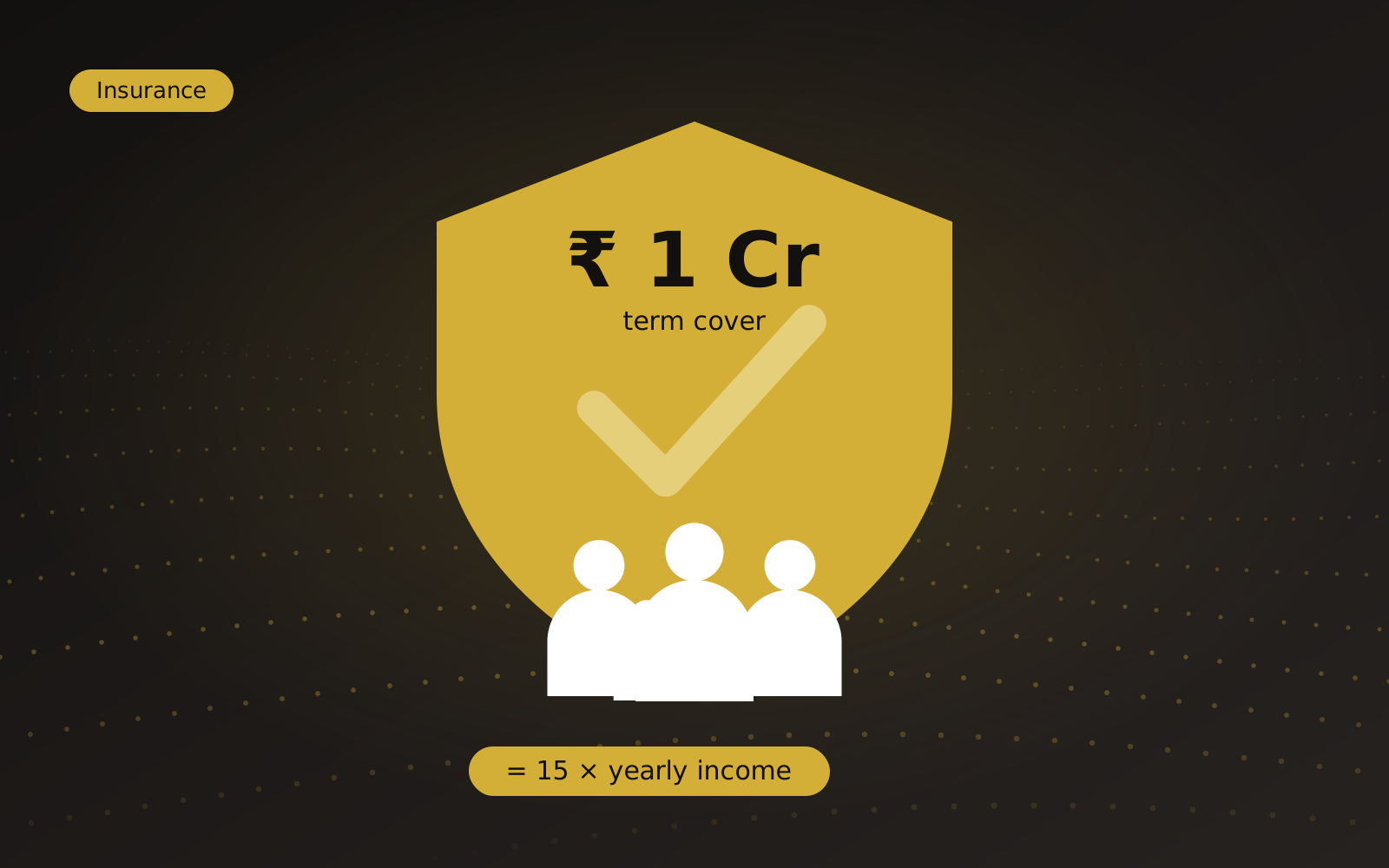
The common thumb rule says cover should be 10 to 15 times annual income. It is useful as a sanity check and nothing more. It misses three things.
- Loans: a ₹1.5 lakh monthly earner with a ₹70 lakh home loan needs far more than someone earning the same with no loan.
- Dependants: a 35-year-old with two toddlers and retired parents has a longer runway to cover than a 50-year-old with grown children.
- Spouse's income: a working spouse with stable income reduces the income-replacement part, sometimes substantially.
Worth knowing
Cover the years your family would need your income, clear the loans, and fund the promises; that is the number.
Run the four-line method first, then see where 10x to 15x falls. If it is lower than your method, trust the method.
Cover till which age, and which riders
A term plan should run until the people who depend on you no longer do. For most, that is somewhere between 60 and 65: children settled, loans cleared, retirement corpus in place. A policy to 85 or 99 costs a lot more and mostly protects nobody, because by then the corpus should be doing the job. Choose a level cover that stays the same throughout. If you are 30 and want cover to 60, buy the 30-year term now rather than in five years; premiums rise with age and a new diagnosis in between can make cover harder to get.
A rider adds a benefit to the base plan for extra premium. Two are often worth a look. A waiver of premium rider keeps the policy alive if you become permanently disabled and cannot pay. A critical illness rider pays a lump sum on diagnosis of listed conditions, though a standalone critical illness policy usually gives wider cover for a similar cost.
Most others are better skipped. Accidental death benefit riders pay extra only if death is by accident, which does not change what your family needs. Return-of-premium options raise the premium sharply for a benefit you can replicate with a simple SIP. Keep the term plan simple and the premium low; put the saving into health cover and investments.
Nominee, MWP Act and disclosure
Name a nominee and keep it current. A term plan bought before marriage often still names a parent. Review it after every marriage, birth or death in the family.
If you have loans or run a business, consider buying the policy under the Married Women's Property Act, 1874. A policy under the MWP Act creates a trust for your wife and children, and the payout is protected from creditors and other claimants to your estate. It has to be chosen at the time of purchase and cannot be added later; ask for the MWP addendum on the proposal form.
Disclose everything on the proposal: smoking, alcohol, every diagnosis, every medication, your actual income and occupation. A term plan is a contract of good faith. Non-disclosure found at claim time is the most common reason a family is refused the money, and by then nothing can be fixed. A slightly higher premium today is a small price for a claim that is paid.
Why a term plan, not a savings policy, for protection
A term plan pays only on death and returns nothing if you survive the term. That is exactly why it is cheap enough to buy ₹2 crore of cover on a middle-class salary. A savings or endowment policy combines a small cover with a long-term savings component, and the cover is usually a fraction of what the family needs.
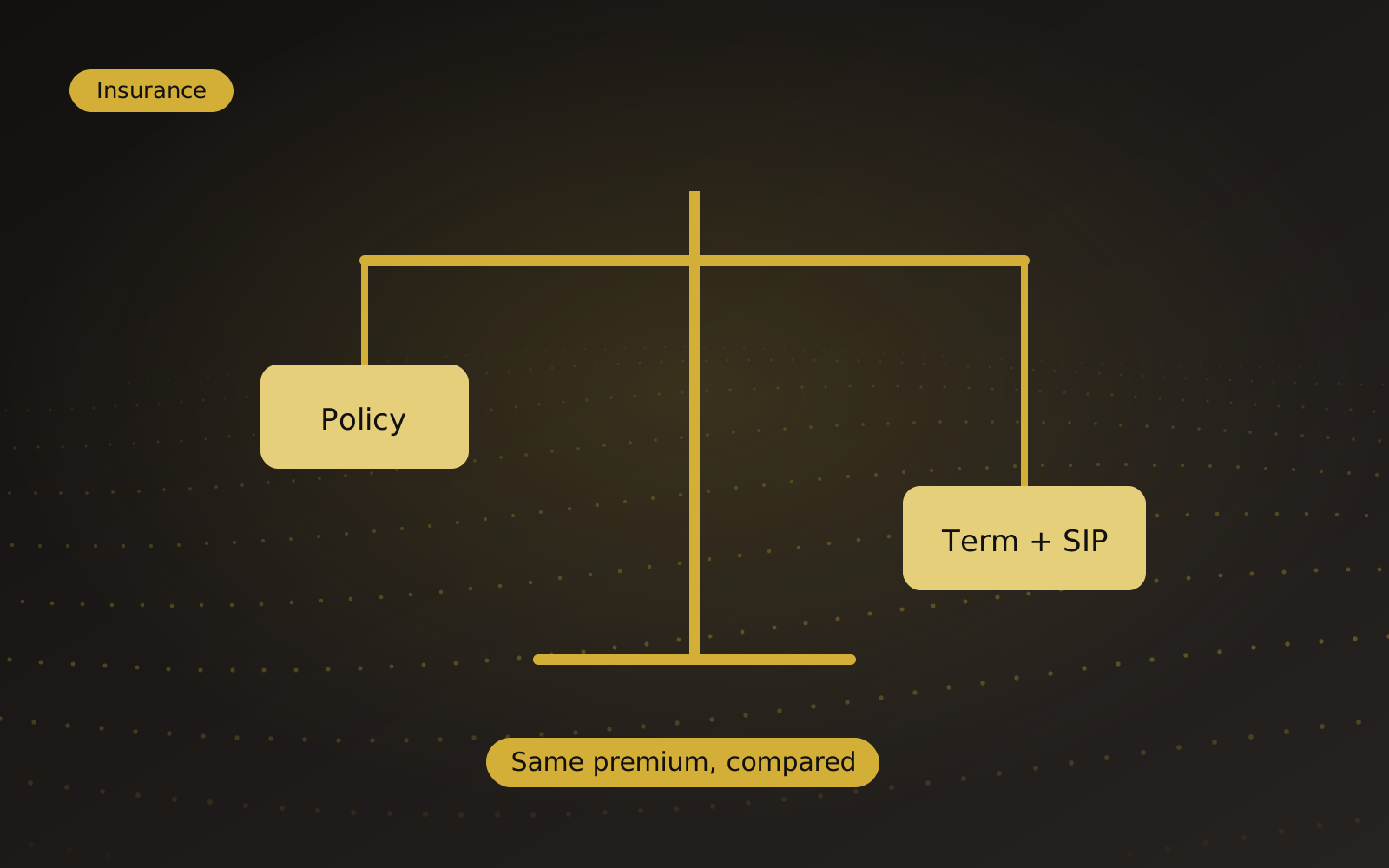
Keep the two jobs separate. Protection comes from a term plan. Savings and investment come from EPF, PPF, NPS and mutual fund SIPs, each chosen for its own purpose and each carrying its own risks. Mixing them tends to leave you under-insured and over-committed to a premium you cannot pause.
What to do this week
- Run the four-line method with your own income, loans and goals on one sheet.
- Check the nominee on every life policy you hold, including employer cover.
- List every diagnosis and medication you would need to disclose on a proposal form.
Bring that sheet to a free 30-minute review and one of our directors will check the arithmetic with you.
This article is for information only and is not investment, tax or legal advice. Figures are illustrative. Mutual fund investments are subject to market risks; read all scheme-related documents carefully before investing. Bhavya Sampada is an AMFI-registered Mutual Fund Distributor, ARN 266666.