The emergency fund: how much, where to keep it, and when to touch it
Keep six months of essential expenses, twelve if you are single-income or self-employed, in a savings account and sweep FDs, away from long-term money.

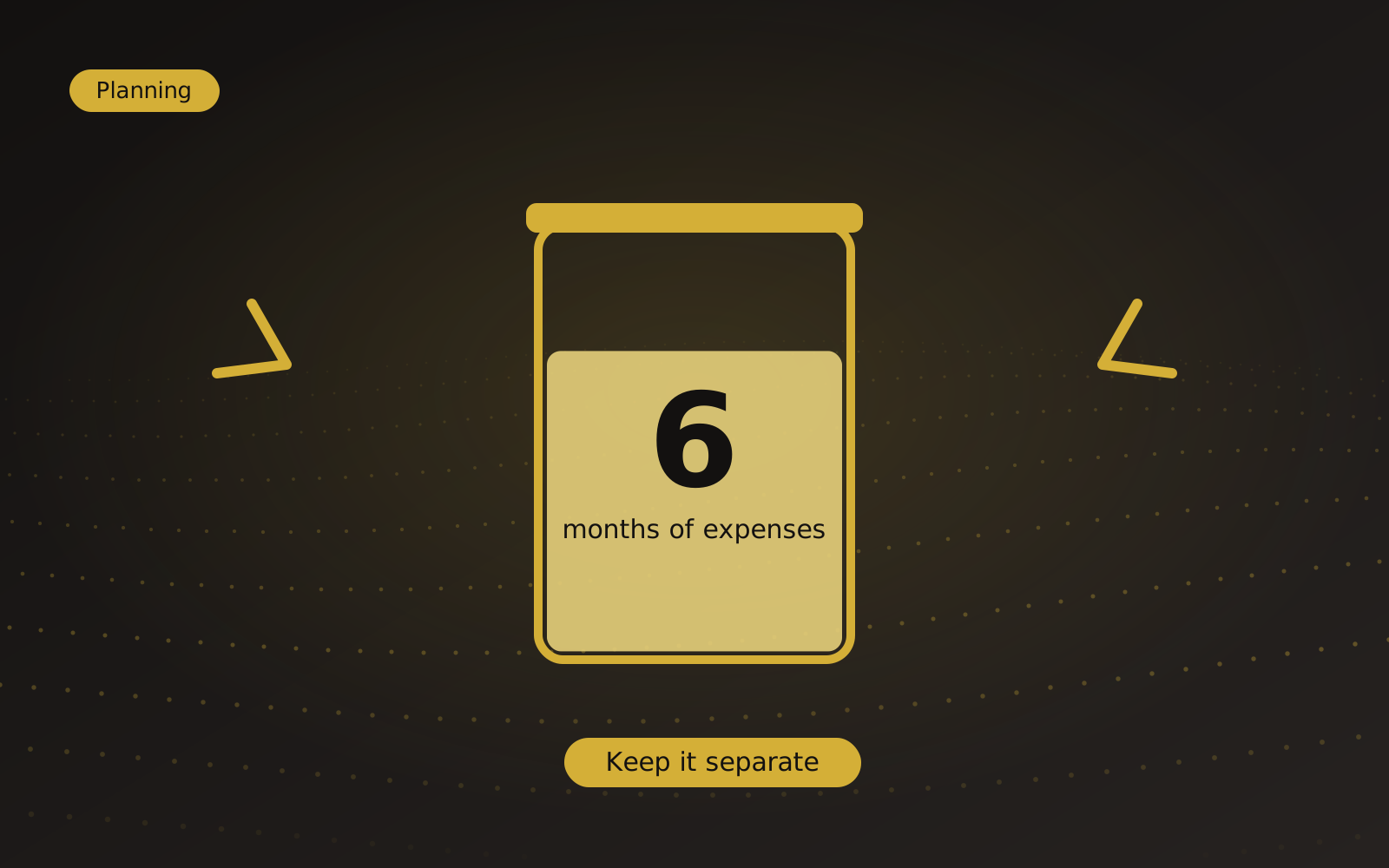
Keep six months of essential expenses in an emergency fund, or twelve if your household has one income or you are self-employed. Hold it in a savings account and sweep fixed deposits, never in the same place as your long-term investments. This guide covers how to work out the number, how to build it in steps, where to park it, what counts as an emergency, and why this one fund quietly protects everything else in your plan.
How much is enough
Start with essential expenses, not total spending. Essential means what you must pay even if income stopped tomorrow: rent or EMI, groceries, utilities, school fees, insurance premiums, medicines, transport to work, and the minimum support you send to parents. Leave out eating out, holidays, new clothes and gadgets.
Say your essential monthly spend is ₹60,000. Six months is ₹3.6 lakh. If you are the only earner, or your income comes from a practice or a business, twelve months is ₹7.2 lakh. That sounds large. It is meant to. The number is what lets you refuse a bad job offer, or wait out a slow quarter, without touching anything else.
If your spouse earns and could cover the essentials alone, six months is fine. If you are a government employee with high job security, six months is still the floor, because medical emergencies and family needs do not care about job security. If you are an NRI with dependents in India, keep a separate rupee fund here for them.
Build it in steps
Nobody fills a ₹7 lakh fund in a month. Set the first milestone at one month of essentials. Then three. Then six. Treat each as a goal in its own right.
- Direct every bonus, arrears or tax refund into the fund until three months are covered
- Set a standing instruction on salary day so the transfer happens before you see the money
- Pause new discretionary spending, not existing SIPs, until the first milestone is met
If you are starting from zero and also running SIPs, do not stop the SIPs. Split new surplus between the two until the fund reaches three months, then let the fund take the larger share until it is complete.
Where to keep it
The fund has two jobs: be there, and be reachable within a day or two. Return is a distant third. So the money goes in places that are boring on purpose.
| Layer | Where | Purpose |
|---|---|---|
| First month | Savings account | Reachable the same day |
| Next two to three months | Sweep-in FDs linked to that account | A little more interest, still instant |
| The rest | Short-term FDs or a liquid mutual fund | Reachable in one to two working days |
Keep it in an account that is not your daily spending account, so it does not blur into monthly money. And keep it far from your long-term investments. The moment the emergency fund sits in the same equity fund as your retirement money, a bad month in the market and a bad month at home can land together.
Worth knowing
An emergency fund is the only money you own whose job is to sit still.
What counts as an emergency, and refilling after use
An emergency is a cost that is unexpected, necessary, and urgent. All three. A hospital bill that insurance has not yet settled. A job loss. A car repair you need to get to work. A parent's sudden medical travel.
What is not an emergency: a sale on a phone you wanted, a wedding gift, a holiday that "everyone is going on", a down payment on a car, a festival. These are planned expenses, even when they feel sudden. They belong in a separate short-term savings pot, not here. The test is simple. Ask whether, if the fund did not exist, you would borrow for this. If the honest answer is no, it is not an emergency.
Using the fund is not a failure. It is the fund doing its job. The failure is not refilling it. After any withdrawal, go back to the standing instruction and rebuild to the full number before you raise any SIP or make any new investment. If the withdrawal was large, give yourself a written timeline, say twelve months, and treat it like a loan repayment to yourself.
Why it protects everything else
Families without an emergency fund still face emergencies. They pay for them by stopping SIPs, breaking fixed deposits meant for a child's education, taking personal loans at high rates, or letting a term plan or health policy lapse because the premium came due in a bad month.
Each of these costs more than it looks. A lapsed term plan may not be reinstated on the same terms. A stopped SIP rarely restarts. A broken education FD is a conversation nobody wants to have with a 17-year-old. The emergency fund is the wall between a bad month and a bad decade. It is the least exciting part of a plan and the one we check first in every review.
What to do this week
- Write down your essential monthly expenses, line by line, and multiply by six or twelve. That is your target number.
- Open a separate savings account, or pick an existing one you do not spend from, and set a standing instruction for salary day.
- Move whatever you already have idle in your spending account above one month's needs into that account today.
If you would like help setting the right number for your household, our directors offer a free 30-minute review and this is always the first thing we look at.
This article is for information only and is not investment, tax or legal advice. Figures are illustrative. Mutual fund investments are subject to market risks; read all scheme-related documents carefully before investing. Bhavya Sampada is an AMFI-registered Mutual Fund Distributor, ARN 266666.