Home loan balance transfer: when it saves money and when it doesn't
A transfer helps when the rate gap is wide, the tenure left is long, and fees are small. Late in a loan it rarely pays. Ask your own lender first.

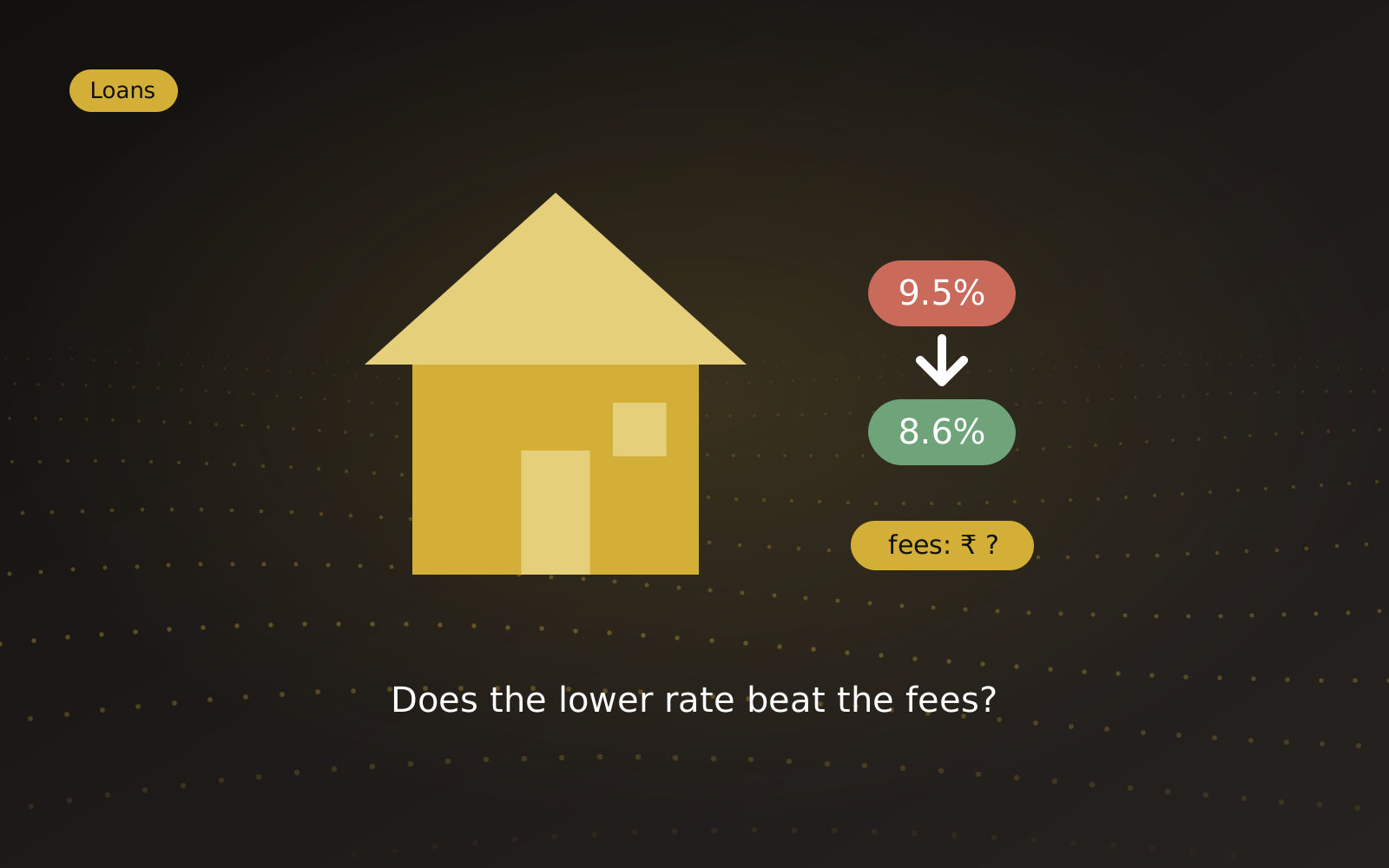
A home loan balance transfer saves money when the new rate is clearly lower, you still have many years left to run, and the fees are small next to the interest saved. If any of those three is missing, the transfer usually costs more than it returns. This guide walks through the arithmetic, the fees people forget, the cheaper first step most borrowers skip, and the top-up pitch that often comes with the offer.
The rate gap and the years left
A transfer is a decision about interest you will not pay in future, not interest already paid. So the question is: over the years left, does the lower rate save more than the move costs?
As a rough rule, a gap under 0.25 percentage points is rarely worth the paperwork. A gap of 0.50 or more, with ten or more years left, usually is. In between, do the sum.
Say your outstanding balance is ₹40 lakh, 15 years remain, and your rate is 9.25 per cent. A new lender offers 8.65 per cent. The interest saved over the remaining tenure runs to several lakh rupees, well above typical fees. Now take the same gap on a ₹12 lakh balance with four years left. The saving shrinks to a few tens of thousands, and after fees it may be close to nothing.
The reason is that an EMI is front-loaded with interest. In the early years most of each payment is interest; later, most is principal. A lower rate works on the interest part, so the same cut saves far more in year three than in year sixteen.
| Years left | Rate gap | Rough verdict |
|---|---|---|
| 15 or more | 0.50 or more | Usually worth it |
| 8 to 15 | 0.50 or more | Do the sum, likely yes |
| Under 5 | Any | Rarely worth it |
Worth knowing
A balance transfer is worth doing only when the interest saved over the years left is clearly larger than every fee paid to move.
The fees people forget
Lenders print the headline rate in large type and the charges in small type. Before you sign, ask for each of these in writing:
- Processing fee at the new lender, often a percentage of the loan
- Legal and technical valuation charges on the property
- Stamp duty on the new mortgage deed, which varies by state
- Foreclosure or switch charges at the old lender (floating-rate home loans to individuals usually have none, but confirm)
- Fresh insurance the new lender may ask you to buy
- Your own time: two to four weeks of document chasing
Add these up. If the total is more than one year of the interest you expect to save, think again.
The simpler first step: ask your own lender
Most borrowers do not know that their current lender will often reset the rate for a small conversion fee, sometimes a flat ₹5,000 to ₹10,000, sometimes a small percentage of the balance. No new documents, no valuation, no new mortgage deed.
Walk into the branch, or write to the loan servicing desk, and say you have an offer from another lender at a lower rate. Ask what they can do. Many will match or come close. Closing half the gap for a fraction of the fees is often the better outcome.
Also check which benchmark your loan is linked to. Older loans may still sit on an internal benchmark that moves slowly. Moving to a repo-linked rate with the same lender can be cheaper than moving lenders.
Prepay, and choose tenure over EMI
Any lump sum you put into the loan reduces principal, and the interest on that principal stops at once. When you prepay, the lender will ask whether you want a lower EMI or a shorter tenure. Choose shorter tenure. Keeping the EMI the same and cutting years off the loan saves far more interest than a lighter monthly payment.
One caution. Prepaying by stopping your retirement SIPs is a trade most families regret. Your home loan has a fixed end date; your retirement does not. Keep the SIPs that fund your retirement running, and prepay from bonuses, surplus income, or money sitting idle. If you must choose, keep the SIP and let the loan run.
Under the old tax regime, home loan interest and principal still carry deductions. Under the new regime, now the default, most of these are not available. Check the current year's rules before a tax angle drives the decision.
The top-up trap
A transfer offer often comes with a top-up loan at the same rate. It sounds convenient: a renovation, a car, a child's fees, all folded into one EMI.
Be careful. The top-up turns short-term spending into a 15-year debt. ₹5 lakh borrowed for a wedding and repaid over 15 years costs far more in interest than a shorter loan, even at a higher rate. If you need a top-up, keep its tenure short, and never take one simply because it was offered.
What to do this week
- Pull your latest loan statement and note the outstanding balance, the rate, the benchmark it is linked to, and the months left.
- Ask your current lender, in writing, what it would cost to reset your rate to today's rate for new borrowers.
- Write down every fee the new lender would charge, add them up, and compare the total to the interest saved over the years that remain.
If you would like a second pair of eyes on the numbers, book a free 30-minute review with one of our directors and bring the loan statement along.
This article is for information only and is not investment, tax or legal advice. Figures are illustrative. Mutual fund investments are subject to market risks; read all scheme-related documents carefully before investing. Bhavya Sampada is an AMFI-registered Mutual Fund Distributor, ARN 266666.