How much do you really need to retire comfortably?
Start from today's monthly spend, adjust for what stops and what grows, inflate it to your retirement year, then multiply by about 25. A starting point, not a verdict.

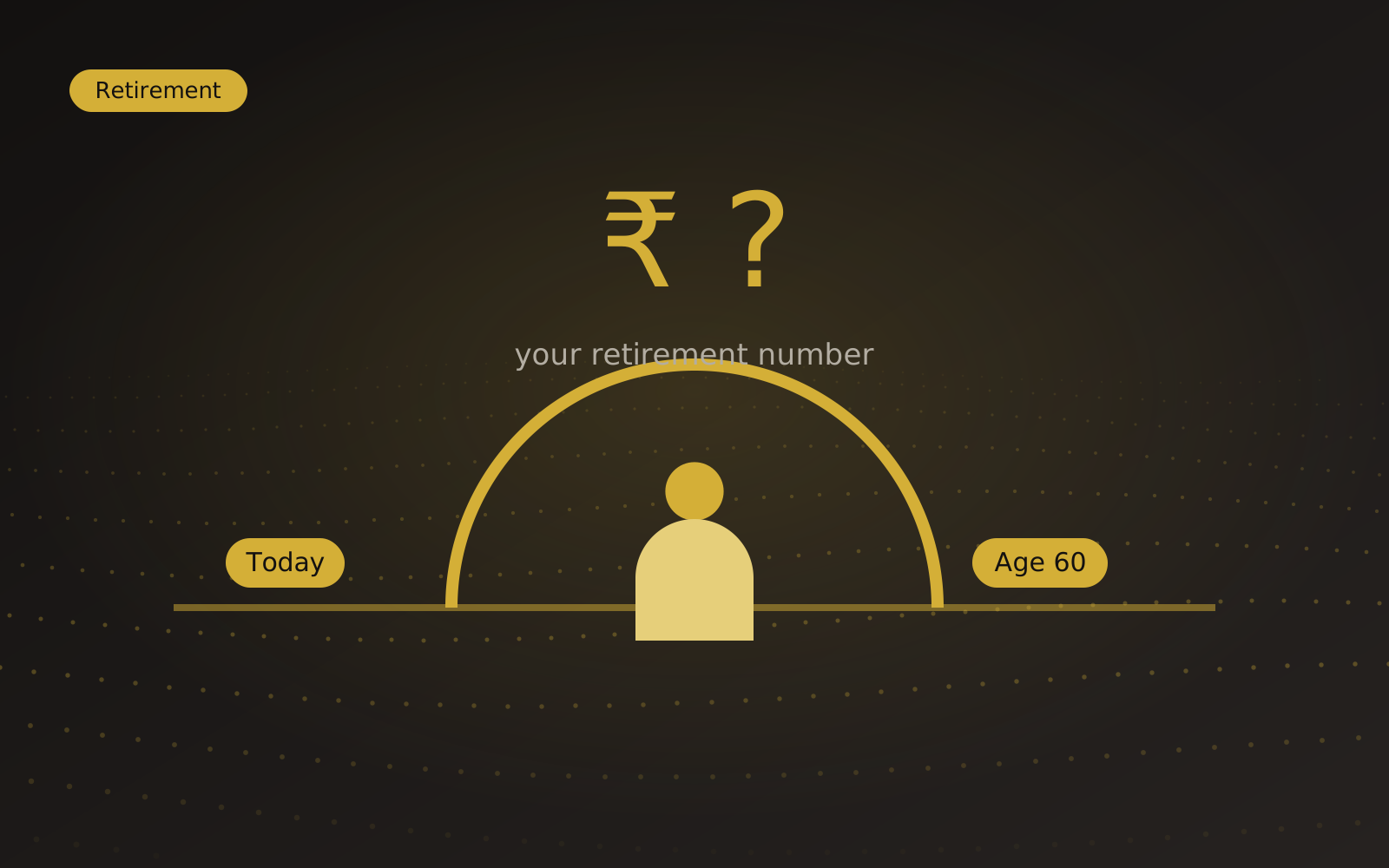
You need roughly 25 times your expected annual spending in the first year of retirement, built from today's monthly budget rather than a round number someone quoted at a party. For most private-sector families that is a larger figure than they expect, because there is no pension to fall back on. This guide shows how to build your own number, where the 25x rule breaks, and how EPF, NPS and PPF fit in.
Start with what you spend today
Do not begin with a target corpus. Begin with your bank statement. Add up what your household actually spends in a normal month: groceries, utilities, fuel, help at home, eating out, subscriptions, gifts, travel averaged across the year. Most families underestimate this the first time, so use three months of statements, not memory.
Then adjust it for retirement. Some costs stop. Home-loan EMIs will usually be cleared by then. Children's school and college fees end. Commuting shrinks. Other costs grow. Health insurance premiums rise steeply after 60, and out-of-pocket medical spending rises with them. You may need help at home later.
The result is your "retirement monthly spend in today's money". Write it down. Everything else builds on it.
Account for inflation honestly
Prices in 2046 will not be prices in 2026. You need an inflation assumption, and it should be modest and clearly labelled as an assumption. We usually assume 6 percent for general spending and a higher figure for medical costs, because hospital bills have risen faster than the overall index for years. Revisit the assumption every few years; it is a guess, not a fact.
Say your retirement monthly spend today is ₹60,000 and you are 20 years from retiring. At an assumed 6 percent a year, ₹60,000 today becomes a little over ₹1.9 lakh a month in 20 years. That is roughly ₹23 lakh a year in your first retirement year. This is illustrative; your own numbers will differ.
The 25x rule and where it breaks
Multiply that first-year annual spend by 25 and you have a rough corpus. In the example above, ₹23 lakh times 25 is about ₹5.75 crore. The rule comes from the idea that drawing a small, inflation-adjusted slice of a balanced corpus each year gives it a reasonable chance of lasting about 30 years. It is a thumb rule, not a promise, and it has three gaps for Indian families.
- Longevity: if you retire at 58 and live to 90, that is 32 years, longer than the rule assumes.
- Medical shocks: one major illness can consume a year's spending in a month.
- No pension: most private-sector people have no indexed pension, so the corpus has to do all the work.
Government employees on the old pension scheme are in a different position and can often plan for a smaller corpus. Everyone else should treat 25x as the floor of the range, not the ceiling. We would rather you aim slightly high and reach it slowly than aim low and run short at 80.
Worth knowing
Your retirement number is 25 times what you will spend in your first retired year, and that spend is today's budget inflated forward.
EPF, NPS and PPF are pieces, not the whole
Many salaried people assume their EPF will cover retirement. It is a strong, tax-efficient piece, and the employer contribution is money you should never leave on the table. But a mid-career salaried person's EPF at 58 is usually a fraction of the corpus above. NPS adds another piece, with the useful feature that part of it must be converted to an annuity, giving you some regular income. PPF is small but safe and useful for the debt portion.
Put all three on one page with current balances and expected contributions. The gap between their likely total and your target is what mutual fund SIPs and other savings need to fill. Mutual fund investments carry market risk, and the gap may close faster or slower than you plan, which is why you review every year.
A worked example, clearly illustrative
Take a 40-year-old in Pune, salaried, planning to retire at 60. This is a made-up example to show the method only.
| Step | Figure (illustrative) |
|---|---|
| Household spend today | ₹80,000 a month |
| Less EMI and school fees, plus health | ₹60,000 a month in today's money |
| Inflated 20 years at an assumed 6 percent | About ₹1.9 lakh a month |
| Times 12, times 25 | Roughly ₹5.75 crore target |
Against that, the family lists an EPF balance, an NPS account and a PPF account. Whatever those are expected to reach is subtracted, and the remainder becomes a monthly savings target spread across equity and debt according to a written plan. The family revisits the target each year, because salary, spending and inflation all move. The number is not the point; the habit of recalculating it is.
What to do this week
- Pull three months of bank statements and total your real monthly spend.
- List your EPF, NPS and PPF balances on one page with their last statement date.
- Build your own version of the table above with your retirement age.
If you would like help checking your number, our directors offer a free 30-minute review with no obligation.
This article is for information only and is not investment, tax or legal advice. Figures are illustrative. Mutual fund investments are subject to market risks; read all scheme-related documents carefully before investing. Bhavya Sampada is an AMFI-registered Mutual Fund Distributor, ARN 266666.